

Have you ever caught yourself spiralling after a tough conversation, convinced you said the wrong thing. Or had tose quick, almost unnoticed reactions like “I’ll never get this right”.
That's just your brain doing what brains do: filling in gaps, jumping to conclusions, and treating feelings like facts. It's incredibly common, and here's the thing - there's a really practical tool that can help you catch those thought patterns before they take over.
It's called a thought record, and it's one of the most well-researched techniques in Cognitive Behavioural Therapy (CBT).
Whether you're working with a therapist or just starting to explore your mental health on your own, understanding how thought records work is a great place to begin.
A thought record (sometimes called a CBT thought diary) is a structured written exercise that helps you slow down, notice what you're thinking, and gently question whether those thoughts are actually accurate.
It's not about being relentlessly positive or silencing your inner critic - it's about getting curious and a little more honest with yourself.
The idea comes from a core principle of CBT: that it's not events themselves that cause us to feel bad, but the meaning we assign to them. CBT recognises that our current thinking shapes how events are perceived - and that perceptions are often more powerful than the actual facts of a situation.
A thought record helps you examine that meaning-making process and decide whether it's really serving you.
Here's a simple example - You send a message to a friend. They don't reply for two days. Your brain fills in the story: "They're ignoring me. I must have done something wrong. They don't like me anymore." A thought record gives you a way to look at that story from the outside - to ask: Is this actually true? What else might explain this?

There's no single universal format, but most thought records work through a similar set of questions. A typical CBT thought record includes:
🗓️ The situation - What actually happened? Just the facts. "My friend didn't text back for two days."
😔 Your emotions - What were you feeling, and how intense was it (0–100%)? "Anxious, 75%. Hurt, 60%."
💭 Your automatic thoughts - What went through your mind in that moment? "She's ignoring me. I must have upset her."
🔍 Evidence that supports the thought - What facts back this up? "She usually replies faster."
🔄 Evidence that doesn't support the thought - What facts push back against it? "She mentioned she had a busy week. She's always been a good friend. I have no reason to think she's upset."
⚖️ A more balanced thought - After weighing the evidence, what's a more realistic view? "It's possible she's just had a hectic few days. I'll check in tomorrow."
😌 How you feel now - Re-rate those emotions. Most people find the intensity drops noticeably after working through the exercise.
Yes - and this is one of the most researched areas in therapy. Research published in the Journal of Behavior Therapy and Experimental Psychiatry found that thought records had a measurably beneficial therapeutic impact on beliefs, anxiety, and behaviour compared to a control condition.
Both thought records and behavioural experiments - two core CBT techniques - showed real-world benefit in tackling unhelpful thinking (McManus, Van Doorn & Yiend, 2012).
A separate study in the journal Biological Psychology found that completing a thought record before a stressful situation affected participants' physiological stress responses, suggesting the technique influences not just how we think, but how our bodies respond (ScienceDirect, 2018).
Put simply - writing your thoughts down and examining them isn't just a journalling exercise. It's a structured cognitive intervention that actually shifts how your brain processes difficult situations - and the more you practise, the more automatic that shift becomes.
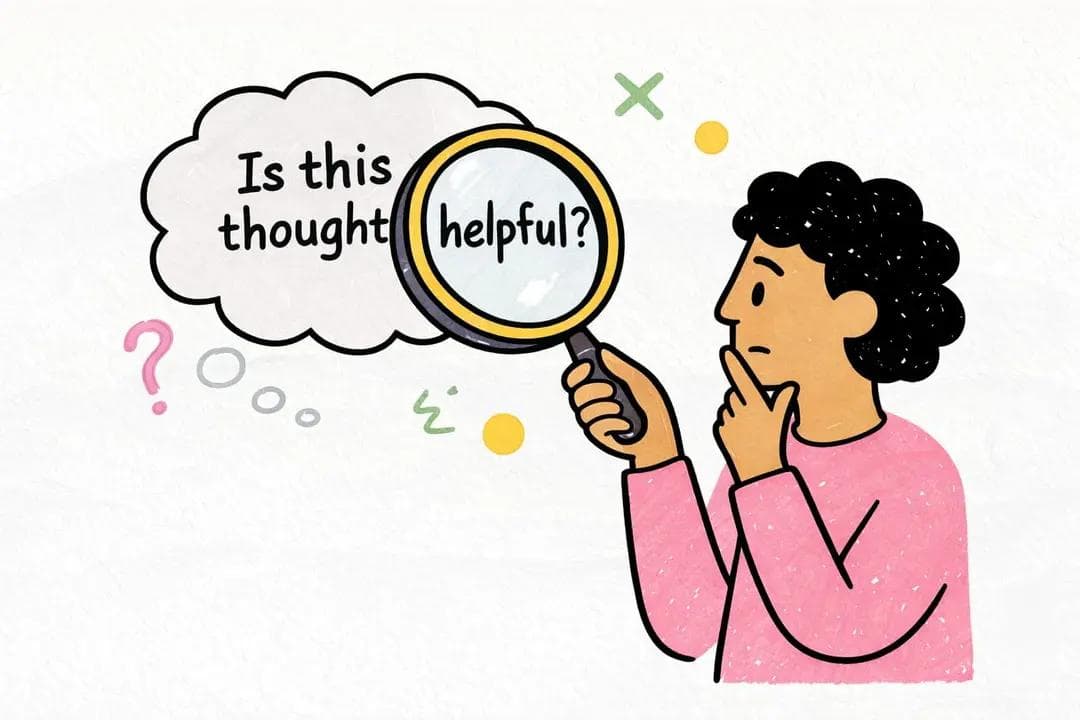
One of the most powerful things a thought record does is help you spot cognitive distortions - those sneaky patterns of thinking that feel completely true in the moment but are actually quite skewed. Harvard Health describes cognitive distortions as "internal mental filters or biases that increase our misery, fuel our anxiety, and make us feel bad about ourselves" (Harvard Health Publishing, 2022).
Here are some of the most common ones a thought record can help you spot:
🖤 All-or-nothing thinking - Seeing things in black and white, with no middle ground. "If I'm not perfect, I've completely failed."
🔭 Catastrophising - Jumping to the worst possible conclusion. "I made one mistake at work. I'm going to lose my job."
🧠 Mind reading - Assuming you know what someone else is thinking - usually something negative. "She gave me a weird look. She definitely thinks I'm annoying."
🙈 Mental filtering - Focusing entirely on the one bad thing while ignoring all the good. "I got great feedback in my review but all I can think about is the one criticism."
🪞 Personalisation - Taking responsibility for things that aren't really your fault. "My friend seems down today - I must have done something to upset them."
Healthline has a clear breakdown of these thinking patterns if you want to read more: healthline.com/health/cognitive-distortions
Read our guide: "What Are Cognitive Distortions? The 10 Most Common Thinking Traps Explained"
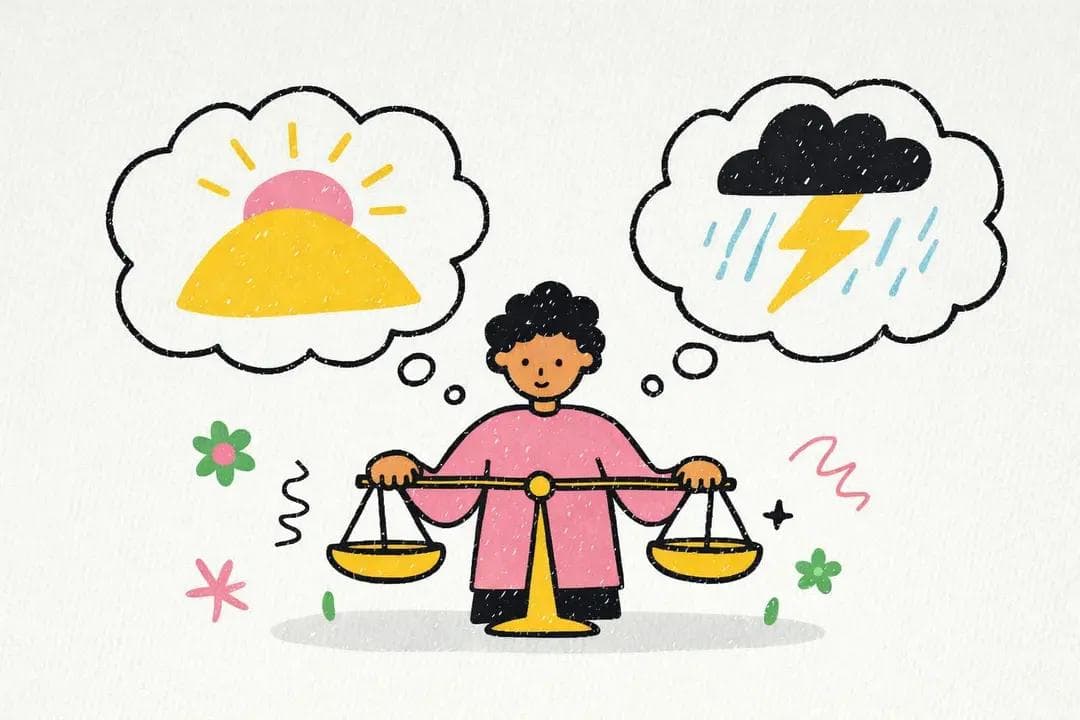
Journalling is wonderful. But it's largely unstructured: you write what you feel, and that process of expression can itself be therapeutic. The risk with unstructured journalling, especially when you're anxious or low, is that it can sometimes deepen a spiral rather than interrupt it. You can end up writing about how bad you feel... and feeling bad.
A thought record is different because it's deliberately structured to move you through a thought, not just deeper into it. The format stops you from ruminating and asks you to engage a slightly different part of your brain - the part that evaluates evidence, considers alternatives, and creates balance.
That cognitive shift is the whole point. Psychology Tools describes it well: the goal of a thought record is to help you develop thinking that is "both helpful and realistic, and unclouded by cognitive biases" (psychologytools.com).
You don't have to wait for a crisis. In fact, thought records are often most useful when used regularly - not just during big emotional moments, but after smaller, everyday frustrations too.
The best time to complete one is shortly after you notice a change in how you feel: a dip in mood, a surge of anxiety, a flash of anger, or a creeping sense of dread about something.
Some great moments to reach for a thought record:
📱 After an awkward interaction on a night out or at work.
📧 After sending something important and immediately second-guessing it.
💬 After a conversation that left you feeling unsettled.
😴 Before bed, if anxious thoughts are keeping you awake.
🌀 When you notice the same worry coming back again and again.
The more you practise, the quicker the process becomes - and eventually, you'll find yourself naturally questioning unhelpful thoughts in real time, without needing to write them down at all.
If you're a therapist sharing Offload tools with your clients, thought records are a natural extension of in-session CBT work. They're most effective when introduced collaboratively - explaining the rationale, modelling the process together in session, and then encouraging clients to complete them as between-session practice.
Research consistently shows that the frequency of thought record practice correlates with greater awareness of dysfunctional thinking (Positive Psychology, 2025). The Offload Thought Record tool is designed to make that between-session practice easy and accessible - lowering the barrier so clients are more likely to actually use it when they need it most.
Read our guide: “How Offload supports therapist-client work: a guide for mental health professionals”
You don't need to be in therapy or going through something serious to benefit from a thought record. You just need to be human - which means you have thoughts, and sometimes those thoughts aren't being entirely fair to you.
Offload's built-in Thought Record tool makes the process simple, private, and genuinely useful. It walks you through each step, so you're never staring at a blank page wondering where to start. Give it a go the next time a thought is sitting heavy - you might be surprised how much lighter things feel on the other side.

Try it free: Use Offload's Thought Record tool
A thought record is a structured CBT exercise that helps you identify automatic negative thoughts, examine the evidence for and against them, and arrive at a more balanced perspective.
It's backed by solid research, widely used by therapists, and one of the most practical self-help tools available for managing anxiety, low mood, and everyday mental health. The more you use it, the more naturally your brain begins to think this way on its own.
Related Articles

What Is CBT? A Plain-English Guide to Cognitive Behavioural Therapy
CBT is one of the world's most researched therapies - but what actually happens in a session? Here's a plain-English guide to how it works and what it can do for you.

What Are Cognitive Distortions? The Thinking Traps That Keep You Stuck (And How to Break Free)
Cognitive distortions are thought patterns that feel completely true but quietly make everything harder. Here's how to spot the most common ones - and what to do when you notice them.